What are on-demand IT experts?
On-demand IT experts give businesses access to specialized technology expertise without requiring a full-time hire for every technical discipline. Organizations can extend their internal IT teams with expertise in cybersecurity, cloud, infrastructure, AI, data, networking, and complex technology projects when those skills or additional capacity are needed.
For growing businesses, the value isn't replacing internal IT. It's giving the internal team a deeper bench.
Demand for Specialized IT Expertise Is Growing
The need for outside technology expertise is not slowing down. Grand View Research estimated the global managed services market at $299.01 billion in 2023 and projected a 13.6% compound annual growth rate from 2023 through 2030. View the managed services market research.
For growing organizations, that trend reflects a practical reality: internal IT teams are being asked to manage an expanding mix of cybersecurity, cloud, infrastructure, data, AI, compliance, and business technology responsibilities.
The question isn't whether your internal IT team is capable. It's whether one team can realistically maintain deep expertise in everything the business now depends on.
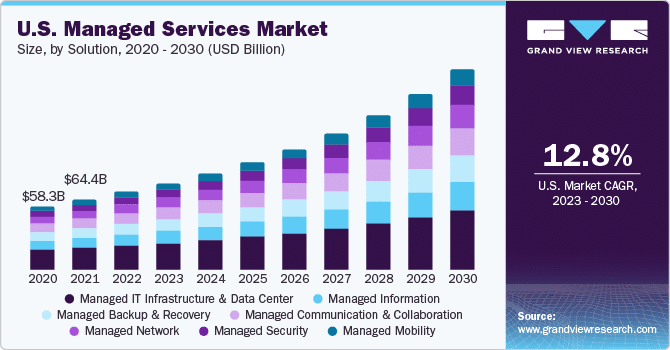
(Source: Grand View Research)
Your IT Team Doesn't Have to Know Everything
According to a study by Scribehow, 42% of businesses cite a lack of in-house IT expertise as a major challenge. This expertise gap can lead to a number of problems, including:
- Security vulnerabilities
- Inefficient operations
- Missed opportunities to leverage new technologies
Good internal IT teams are invaluable. They understand the people, systems, workflows, history, and technology choices that keep the business running.
But expecting one internal team to maintain deep expertise across every technology discipline is becoming increasingly unrealistic.
Cybersecurity. Cloud. AI. Networking. Infrastructure. Compliance. Data. Automation. Physical security. Business continuity. The list keeps growing.
When a major migration, security initiative, acquisition, construction project, or technology failure lands on the team's desk, the problem is not necessarily competence. It is capacity and specialization.
That is where on-demand IT expertise changes the equation.
What Does On-Demand IT Expertise Actually Mean?
On-demand expertise gives an internal IT organization access to specialists when the business needs them without requiring the organization to hire a full-time employee for every discipline.
Your internal team continues owning the business and its technology environment. Outside specialists step in where additional depth, capacity, or project expertise is required.
- Cybersecurity and compliance
- Cloud architecture and migration
- Network and infrastructure modernization
- AI readiness and governance
- Data and analytics
- Structured cabling and ICT
- Business continuity and disaster recovery
- Application development and automation
- Mergers, acquisitions, and technology integrations
- Complex technology projects
Use the right expertise for the problem instead of forcing every problem onto the same people.
When Should You Augment Your Internal IT Team?
1. Your Team Is Good, but It Is Maxed Out
An IT Director may already have a strong team handling users, systems, tickets, vendors, and operational priorities. Then the organization decides to migrate infrastructure, strengthen cybersecurity, open another location, integrate an acquisition, or adopt AI.
Suddenly the same team is expected to run the business and transform it. On-demand expertise creates additional capacity without requiring the existing team to abandon daily operations.
2. You Need a Skill You Do Not Need Full Time
A growing organization may need sophisticated cybersecurity strategy without needing another full-time security executive. It may need cloud architecture for a migration, network engineers for an infrastructure refresh, or expertise assessing whether the organization is ready to adopt AI.
3. You Are Starting a Complex Project
Major technology projects cross disciplines quickly. An office expansion can involve networking, wireless, structured cabling, security, cloud connectivity, access control, AV/conferencing, and vendor coordination. An acquisition can touch identity, infrastructure, applications, data, licensing, security, networks, and business processes.
The project does not stay neatly inside one technical specialty. Neither should the expertise supporting it.
Staff Augmentation vs. Managed IT Services: What Is the Difference?
IT staff augmentation generally adds specific resources or expertise to supplement an existing team. Managed IT services can provide ongoing operational responsibility for defined technology functions.
Some organizations need one. Many growing companies need a blend. Bridgehead can support an internal IT organization where additional capabilities are needed while helping leadership determine which functions make sense to keep internally and which are better supported externally.
The goal is not outsourcing for the sake of outsourcing. It is building the right operating model for the business.
What Skills Should an On-Demand IT Partner Bring?
A large team does not automatically mean a deep team. Ask whether the organization can provide relevant expertise across the areas most likely to intersect with your technology environment.
Managed IT Services
Operational support, systems management, infrastructure, and technology guidance.
Cybersecurity & Compliance
Cybersecurity operations, security strategy, governance, compliance, audit readiness, and risk management.
Cloud
Cloud migration, hybrid environments, Microsoft technologies, infrastructure modernization, and optimization.
AI & Enterprise Intelligence
AI readiness, governance, data strategy, and enterprise intelligence initiatives.
Infrastructure & ICT
Networking, structured cabling, wireless infrastructure, physical security, AV/conferencing, and related technology infrastructure.
Applications, Data & Automation
Application development, systems integration, workflow automation, data, and analytics.
Different organizations will use different combinations. That is the point.
Why Businesses Use On-Demand Experts Instead of Hiring for Every Role
Faster Access to Specialized Expertise
Hiring specialized technical talent takes time. Projects and security risks generally do not wait for recruiting cycles. An established technology partner can provide access to the relevant discipline when the requirement appears.
Access Specialized Skills Without Hiring Every Specialty
Building every technology discipline in-house can require separate expertise across cybersecurity, cloud, infrastructure, data, development, compliance, and AI. On-demand expertise lets businesses maintain the internal team that understands the organization while adding specialists when a particular skill, project, or challenge demands them.
The goal is not simply reducing headcount. It is getting the right expertise at the right time without building every specialty into permanent payroll.
Better Use of Internal Talent
Internal IT professionals should not spend every day responding to issues they are not ideally positioned to solve. Additional expertise lets the internal team focus on the work where its knowledge of the business creates the greatest value.
More Flexibility
Technology priorities change. A cloud architect may be critical during one phase, cybersecurity expertise may dominate the next, and an infrastructure engineer may become essential during an expansion. A flexible model lets the expertise change as the business changes.
Keep Pace With Technology Without Chasing Every Trend
Technology changes faster than most internal teams can reasonably specialize in every new platform, threat, architecture, and emerging technology. The value of outside expertise is not chasing whatever is newest. It is having access to people who work deeply in specialized disciplines and can help determine what matters to your environment and what does not.
That distinction is increasingly important with cybersecurity, cloud, AI, and infrastructure decisions, where adopting technology without the right strategy can create more complexity instead of less.
Better Technology Decisions
A specialist who has encountered the same architecture, migration, security challenge, or failure across multiple environments may recognize risks and alternatives that are not immediately obvious to an internal team dealing with the issue for the first time.
What Should You Ask an IT Partner Before Extending Your Team?
- Do you employ the people doing the work, or subcontract delivery?
- Which technical disciplines exist in-house?
- Who owns accountability when a project crosses multiple specialties?
- Can your experts work alongside our existing IT team?
- How do you document the environment and transfer knowledge?
- Are recommendations vendor-agnostic?
- Can you support multiple locations?
- Can you demonstrate your own security practices?
Bridgehead IT is ISO/IEC 27001 certified, providing independently validated evidence of a formally managed information security program. If you are bringing another technology organization inside your environment, its own security discipline deserves scrutiny too.
Local Expertise. Global Capability.
Bridgehead IT is headquartered in San Antonio with an office in Houston and supports clients across the U.S. and 40 countries. Organizations can access specialized technology expertise while maintaining one accountable partner across locations and disciplines.
For multi-location and distributed organizations, that consistency can be particularly valuable.

Do You Need More IT People or More IT Capability?
Adding another person to the IT team may solve a capacity problem. It may not solve a cybersecurity, cloud, infrastructure, AI, compliance, or architecture problem.
Sometimes you need another pair of hands. Sometimes you need someone who has solved the specific problem before.
The goal is not to replace a strong internal IT team. It is to make that team stronger.
Bridgehead IT provides access to expertise across managed IT, cybersecurity, cloud, AI and enterprise intelligence, applications, data, networking, and ICT infrastructure so businesses can bring the right capabilities into the room when they are needed.
Guaranteed outcomes that bring peace of mind and improve your bottom line.